
NYC DOB Pro-Cert vs. Standard Filing: What Commercial Project Teams Need to Know
Standard Review & Professional Certification (Pro-Cert) Review
For commercial tenant fit-outs and renovations in New York City, one of the earliest permitting decisions is whether a project can use Professional Certification (Pro-Cert) or must proceed through Standard DOB plan examination.
The choice can significantly affect permitting timelines and project scheduling. Pro-Cert can provide a faster path to approval, but it is not simply an expedited version of standard review. It places responsibility on the project's Registered Design Professional (RDP)—a New York State licensed Professional Engineer (PE) or Registered Architect (RA)—to certify compliance with the NYC Construction Codes, Zoning Resolution, and applicable laws and rules.
What Is a Standard Filing?
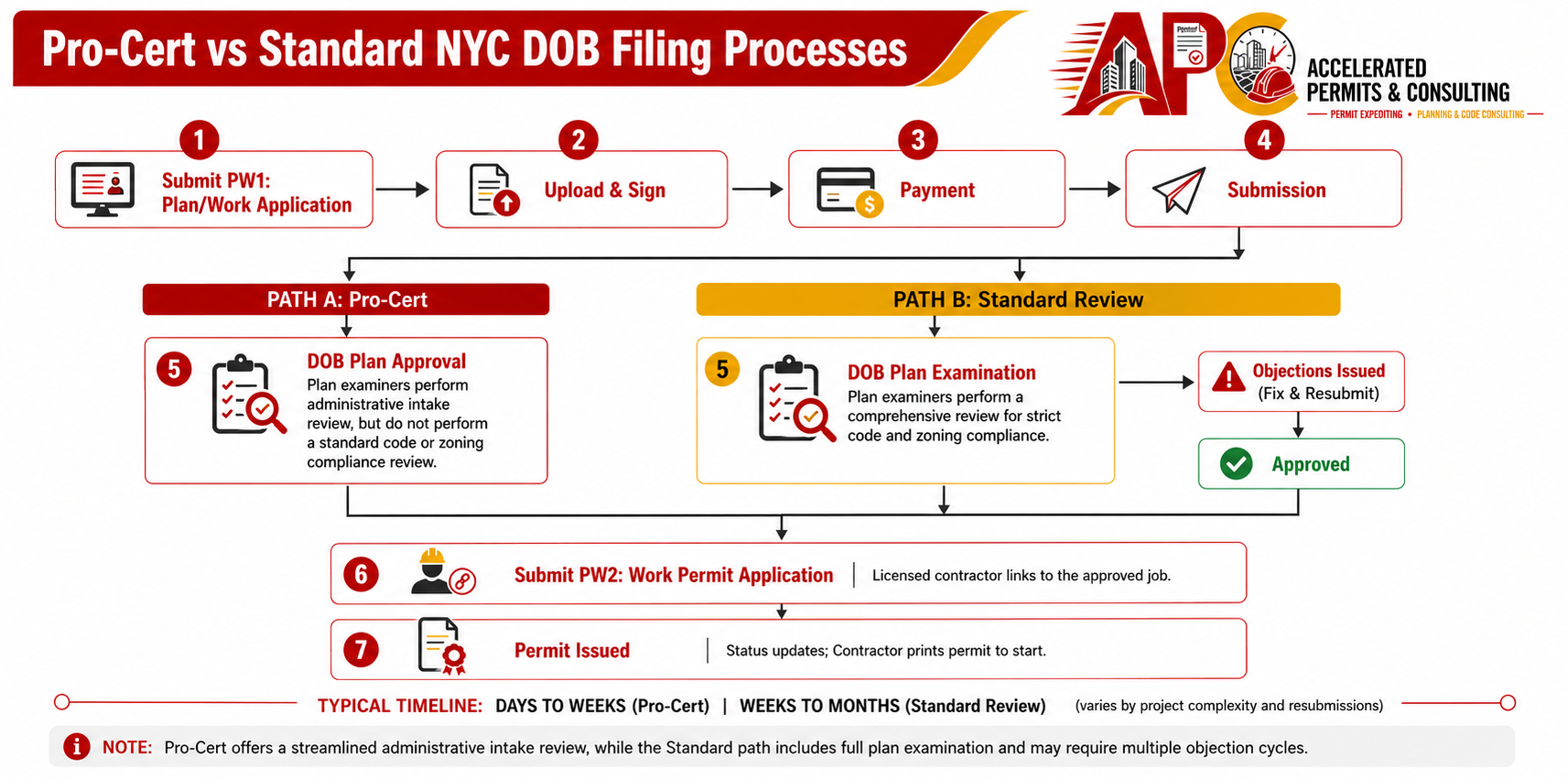
Under a standard filing, DOB plan examiners conduct a comprehensive review of the submitted plans and documents for applicable building and zoning code compliance. If deficiencies are identified, DOB issues objections that must be addressed before approval. The design professional revises the documents, responds to the objections, and resubmits the filing for another review cycle. Depending on project complexity, multiple cycles may be required. Standard review is also required in certain situations involving specific property conditions, project types, or other agency approvals.
What Is Pro-Cert?
Professional Certification allows a PE or RA acting as the Applicant-of-Record (AOR) to certify that the application and construction documents comply with applicable codes, zoning requirements, laws, and DOB rules. Rather than undergoing a standard DOB code and zoning examination before approval, an eligible Pro-Cert filing proceeds through an administrative intake review. DOB retains the authority to audit professionally certified applications after approval.
Pro-Cert can significantly reduce permitting time, but it does not reduce the project's code or zoning requirements. The RDP assumes responsibility for certifying that the filing is complete, coordinated, and compliant.
Pro-Cert vs. Standard Review: Timeline Differences
The choice of filing pathway can have a substantial impact on project schedules.
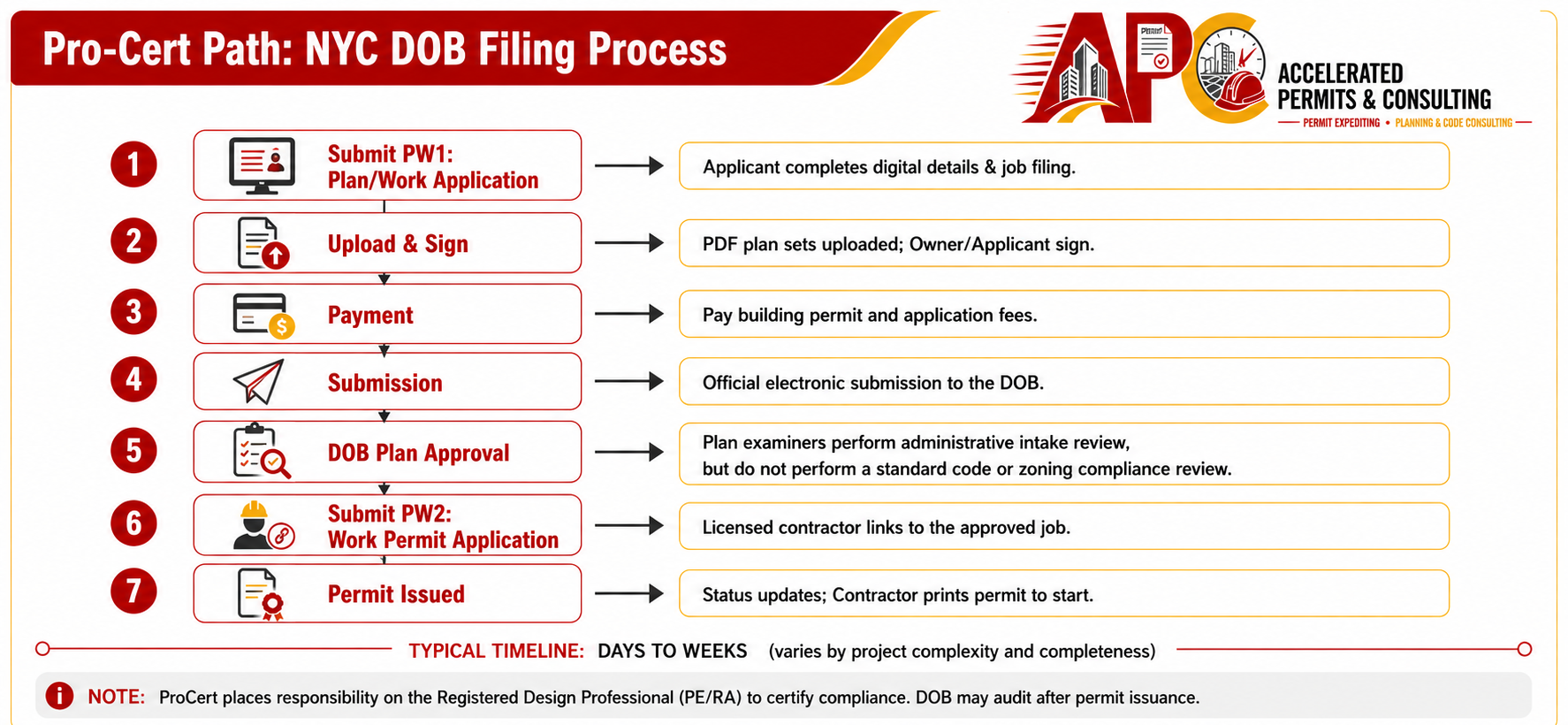
Pro-Cert Review Timeline
For an eligible Pro-Cert filing with no administrative objections, DOB's administrative intake review typically takes approximately 48–72 hours. Once approved, the contractor submits the PW2: Work Permit Application, which typically takes another 24–48 hours when complete. A properly prepared Pro-Cert filing can therefore potentially reach permit issuance in as little as approximately five business days.
Standard Review Timeline
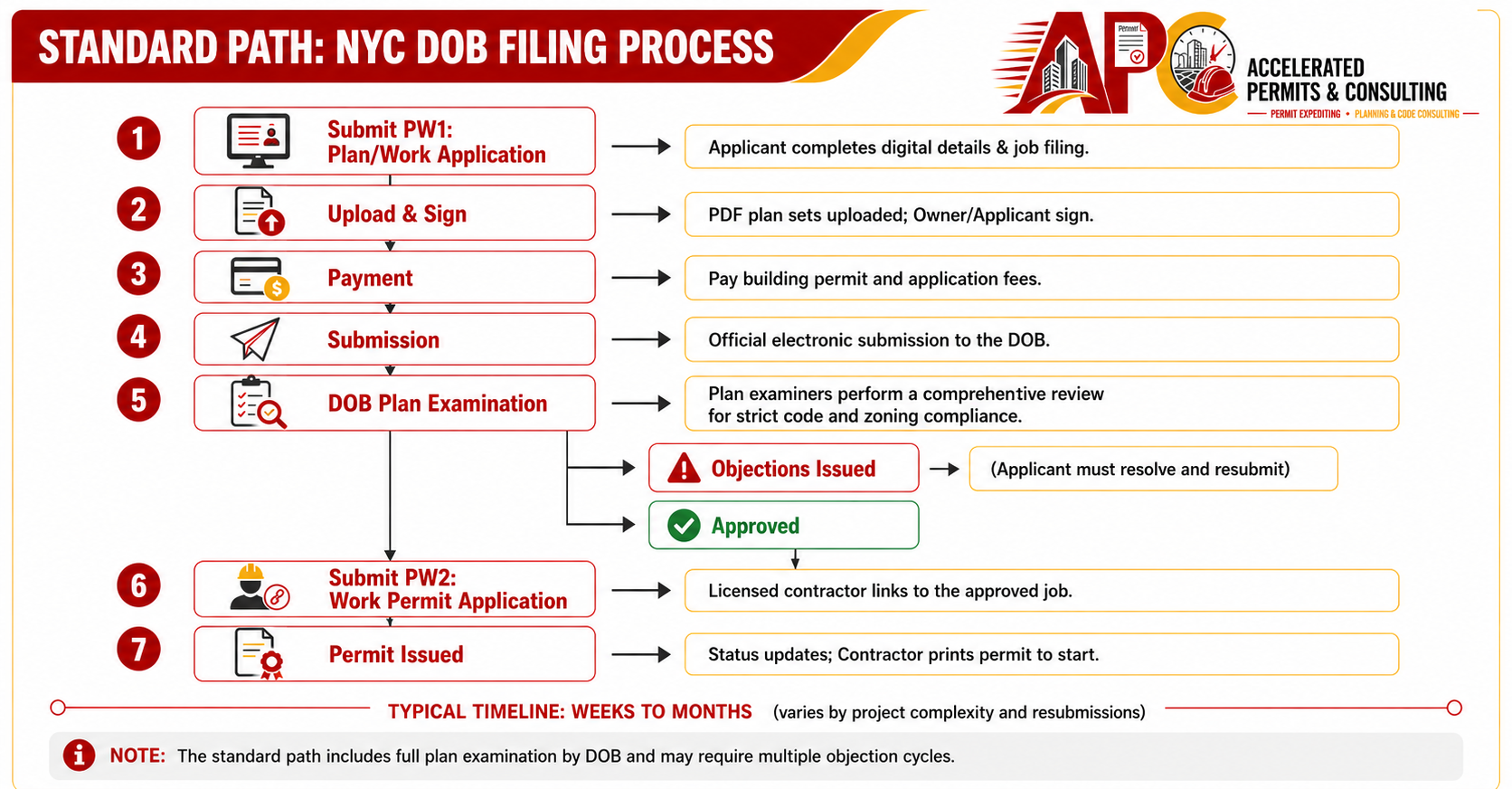
Standard review involves a comprehensive DOB examination for building and zoning compliance. Objections may trigger multiple revision cycles, with each cycle potentially taking approximately 1–3 weeks.
For a commercial Alteration Type 2 (Alt-2) tenant fit-out, Standard review should generally be expected to take at least four weeks, with many projects taking 4–8 weeks or longer depending on the number and complexity of objection cycles. Following plan approval, the PW2 typically takes another 24–48 hours.
Comparing Pro-Cert / Standard Review Timelines
The timeline difference can therefore be substantial: Pro-Cert may allow an eligible project to move from filing to permit in approximately five business days, while Standard review can take four to eight weeks or more.
Eligibilty for Pro-Cert Review vs. Standard Review Requirements
Buildings Bulletin 2025-005, issued by DOB on June 3, 2025, revised the Professional Certification Program and established the current requirements governing Pro-Cert eligibility and procedures. Project teams should review the current DOB requirements before determining whether a filing qualifies.
What Types of Work Can Be Professionally Certified?
Subject to applicable restrictions, Pro-Cert may be available for:
General construction and interior alterations
Mechanical work
Plumbing work
Structural work
Excavation and earthwork
Related construction documents and amendments
For commercial tenant fit-outs, this can include many typical retail, restaurant, QSR, and office alterations.
Eligibility depends on the specific filing, property, scope of work, and applicable restrictions—not simply on the fact that a project is a tenant fit-out.
What Requires Standard Filing?
Certain applications are specifically excluded from Pro-Cert. Under the current requirements, these include:
1. Subdivisions
2. Full demolitions and applications containing demolition work that includes the use of mechanical equipment, other than handheld equipment, per BC Section 3306.5
3. Applications for work on projects that require, or are related to projects that require any approval, permit, or another type of determination from the Board of Standards and Appeals (BSA).
Additionally, effective July 1, 2025, the following applications cannot be professionally certified:
4. Support of Excavation (SOE) and Underpinning applications.
5. Loft Board compliance applications.
6. Authorization for Temporary Residence per AC28-507 enacted by Local Law 126 of 2024: Legalization of eligible basement and cellar residences filed under the pilot program enacted by Local Law 126 of 2024.
7. Buildings with Residential Occupancy involving Demolition ((partial or full (DM)) applications regardless of work types, or work involving GC or ST work types related to ALT, ALTCO, or ALTCO-NB applications in the following Anti-Harassment Districts of the Zoning Resolution:
a. Greenpoint-Williamsburg anti-harassment area (ZR 27-20)
b. Subareas D4 or D5 in the Hell’s Kitchen Subdistrict D (ZR 93-91)
c. Special Clinton District Preservation Area (ZR 96-107)
d. Special Clinton District Perimeter Area (ZR 96-20)
e. Special West Chelsea District (ZR 98-70)
f. Subdistrict A-2 of the Special Garment Center District (ZR 121-60)
Additional restrictions may apply depending on the property's history, including certain properties affected by Local Law 158 of 2017 and recent work-without-permit violations.
Certain projects involving Landmarks Preservation Commission (LPC), City Planning Commission, or other agency approvals may also require those approvals or determinations before Pro-Cert can be used.
The key takeaway is that there is no simple rule that all Alt-2 projects qualify for Pro-Cert or that all major projects require Standard review. Eligibility must be evaluated based on the specific project and current DOB requirements.
Choosing the Right Filing Strategy
For NYC commercial projects, Pro-Cert and standard filing are two different paths to DOB approval—not two different levels of code compliance.
A standard filing places the initial plan examination responsibility with DOB. Pro-Cert allows an eligible PE or RA to certify compliance and bypass the normal full plan-examination process, subject to DOB acceptance and potential audit.
For many retail, restaurant, QSR, and office tenant fit-outs, Pro-Cert can provide a valuable permitting advantage. But eligibility must be evaluated on a project-by-project basis, particularly when zoning issues, prior violations, landmark or other agency approvals, special building conditions, or other restrictions are involved.
The goal is not simply to choose the fastest filing pathway. It is to choose the right pathway for the project while minimizing avoidable permitting delays.
